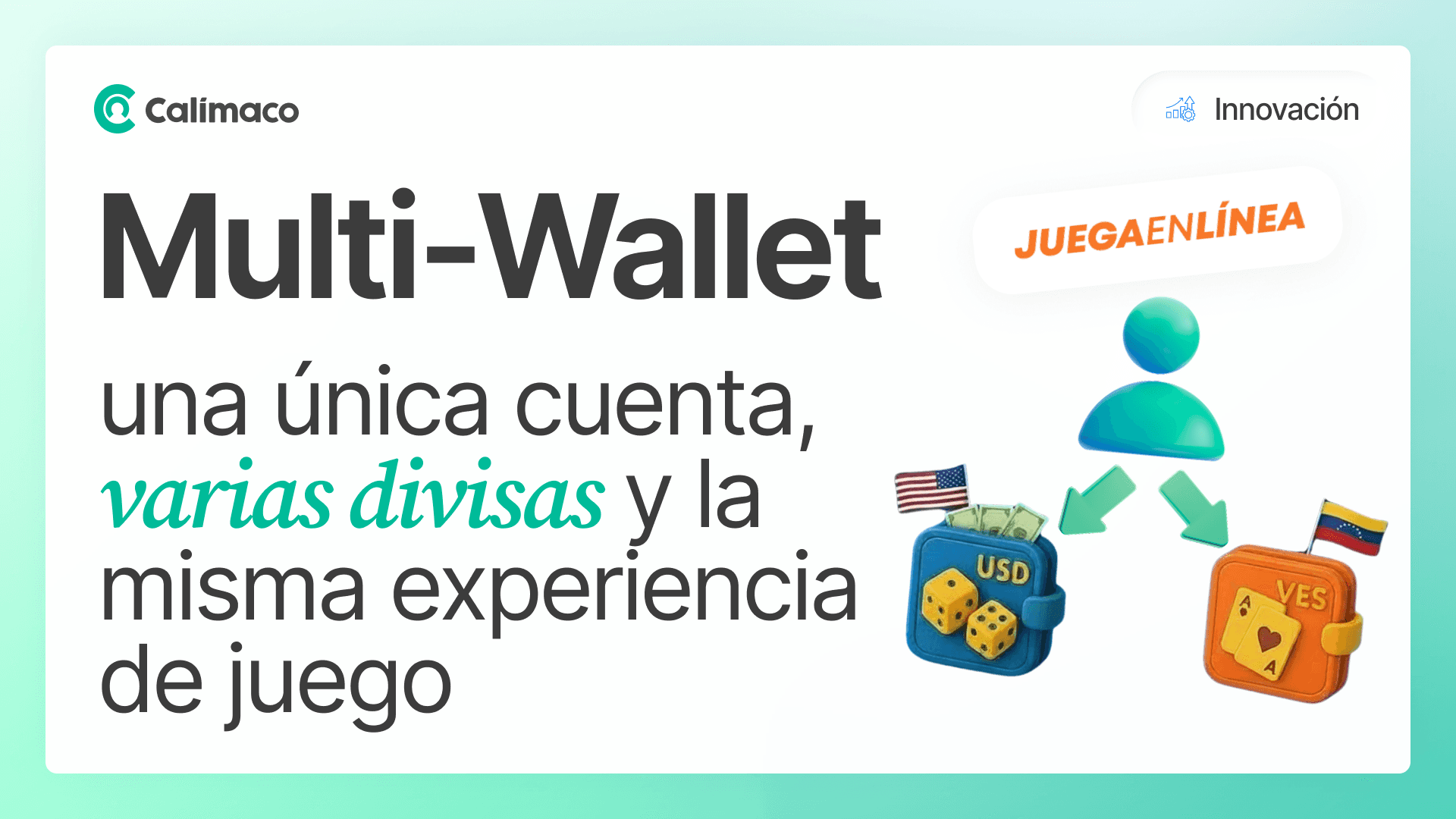
Multi-Wallet: when the platform adapts to the player's economic reality
Operations that grow faster are not always those that continuously offer more products, a larger catalog of games or more and better marketing campaigns.
They tend to have something in common: they understood before the rest how the minds of their players really work, know their tastes, and, above all, adapt to their economy. From this understanding, they make key decisions such as adapting their offer and technology to that reality, instead of forcing the player to adapt to a limited platform.
This leads to questioning inherited models, reviewing assumptions that for years were considered good and effective, and building solutions that respond to the current economic market context. And it is in these environments where models like the Multi-Wallet arise, a solution designed for markets where a single currency is no longer sufficient to operate efficiently, neither for the player nor for the platform.
But what exactly is the Multi-Wallet? In what type of markets does it make sense? And why do these types of developments increasingly make the difference between standard platforms and real technology partners?
When the official economy does not match the real economy
Nowadays, in many regulated markets, there is no clear official currency, or currency is shared with another country. This does not mean that this currency is the only one with which players operate in their daily lives.
An evident example is Venezuela, where the bolivar is the official currency, but where much of the economy, especially day-to-day transactions, is deeply dollarized. Players think, save, pay and compare prices in different currencies regularly.
And the problem for operators arises when their platform does not reflect that reality. And this is not a perception issue, it is more of a structural problem.
So, what exactly is the Multi-Wallet model?
The Multi-Wallet model, developed and put into production together with our partner Juega En Línea, allows the same player to operate with two independent wallets in different currencies, maintaining a single profile within the platform.
It is not about duplicating accounts or creating parallel experiences. The player accesses with the same identity and the same gaming conditions, being the one who decides which currency they wish to operate with at any given time.
And the key is not in adding complex processes, but in detecting a user need and facilitating playability. From the user's point of view, duplicate accounts are eliminated, their gaming experience is improved, and they can choose which currency they wish to play with.
From the platform's point of view, each wallet maintains independent flows, which allows them to manage each currency in a more controlled way, without mixing balances or causing operational failures.
It should be noted that the Multi-Wallet relies on an architecture specifically designed to manage multiple currencies from the start, allowing for a solid, scalable operation aligned with markets where a single currency does not reflect the economic reality experienced by the player.
And is this a replicable solution?
Yes, it can be replicated, but not in a generic way, as it is not a functionality intended for all markets but was thought of and designed as a specific solution for a real need of a specific client.
Nonetheless, it makes sense in contexts such as economies that are bimoney or de facto dollarized, or where the operation requires greater control by currency.
Additionally, this model is designed to work with more combinations of currencies, such as pounds and euros or dollars and Mexican pesos, currently developed to support two different currencies, with the possibility of expanding to more currencies.
From standard functionalities to tailored solutions
For many years, the vast majority of platforms have operated under the same closed approach where the client adapts to the product, not the other way around.
However, for better or worse, markets change increasingly rapidly, and the Multi-Wallet is a clear example of this, where faced with a specific need and in collaboration with Juega En Línea, technology can and should adapt to the client's reality. It presents itself as a logical response to the new reality of the market.
And this new functionality does not arise from the pursuit of selling more, it arises from listening to a real problem of our partner, understanding its operational impact, and together building a solution that works and solves a real problem.
The question you should ask yourself is not whether you need this new functionality or if the Multi-Wallet is going to work for you. The question is: when a real need arises in my operation, does my provider adapt or ask me to adapt? Is my provider prepared to assist me with these operations?